Aerial cables, unlike underground cables that are installed beneath the soil or inside ducts, are placed on poles, supports, and insulators, exposed to the open air. This category of conductors must withstand environmental factors such as wind, ice accretion, ultraviolet radiation, temperature fluctuations, and atmospheric pollution. Therefore, technical expertise in selecting raw materials, designing the cross‑section, and manufacturing methods becomes doubly important. In our factory, utilizing advanced equipment and quality control laboratories, we produce all types of aerial cables in accordance with national and international standards such as IEC, BS, and ANSI, thereby ensuring the required service life and safety for power grids.
Generally, aerial cables are divided into two main groups: bare conductors (uninsulated) and insulated or covered aerial cables. Each of these groups is designed for specific voltage levels and operating conditions.
1. Bare Aerial Cables
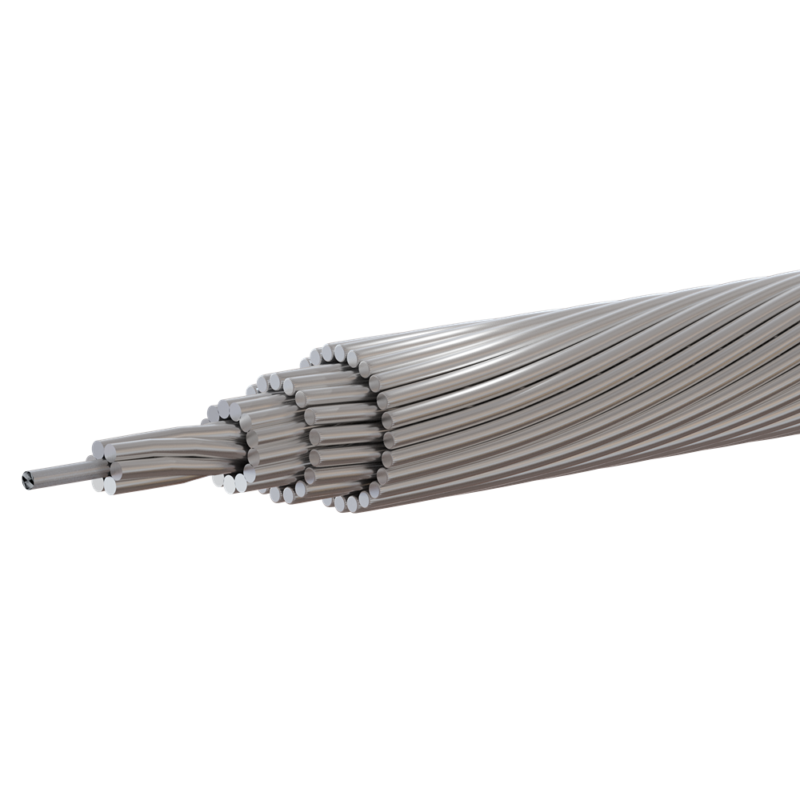
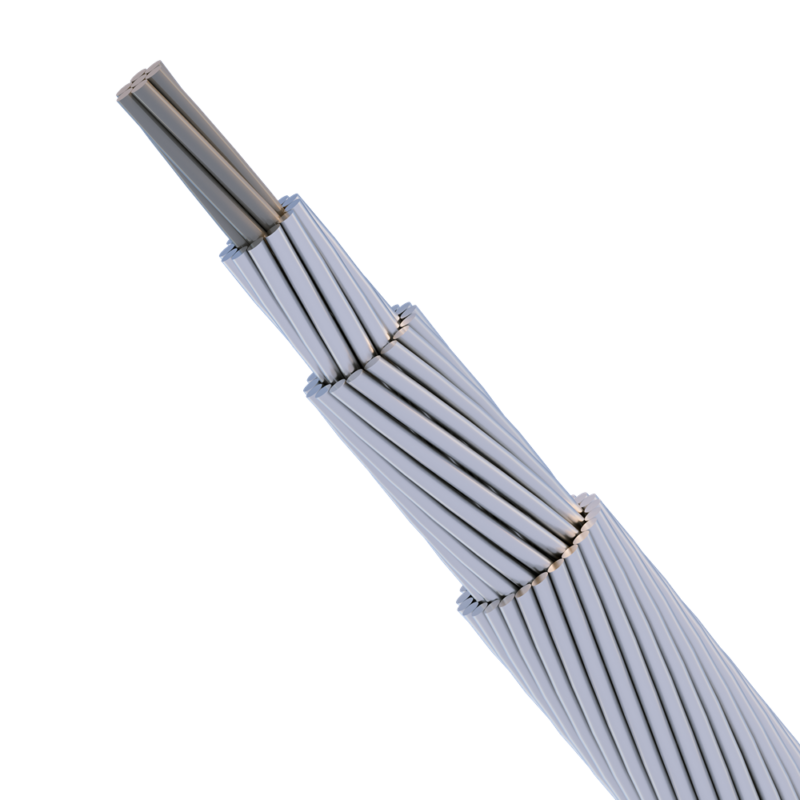
These are the first and most widely used group. They consist of metallic strands twisted together without any insulating covering. The most renowned type is the Aluminum Conductor Steel Reinforced (ACSR).
In this cable, a galvanized steel core with high tensile strength withstands the mechanical forces caused by the conductor’s weight and wind pressure, while the outer aluminum layer(s) carry the electric current. The smart combination of these two metals creates an exceptional strength‑to‑weight ratio, enabling its use in high‑voltage transmission lines with long spans.
Another type is the All‑Aluminum Conductor (AAC), which has very high conductivity and is ideal for short spans in urban distribution networks where mechanical strength is a secondary priority. However, its mechanical weakness compared to ACSR limits its application over long distances. To overcome this challenge, aluminum alloys such as AAAC (All‑Aluminum Alloy Conductor) were developed. By adding elements like magnesium and silicon, AAAC offers acceptable conductivity while providing higher tensile strength and hardness than AAC, and it is completely immune to galvanic corrosion between dissimilar metals. This feature makes AAAC highly suitable for coastal and industrial areas with high corrosivity.
The production of bare conductors in our factory includes precise steps: drawing aluminum and steel wires to standard diameters, annealing to achieve desired electrical and mechanical properties, and then regularly stranding these wires around the central core using precision stranding machines. Every finished coil undergoes rigorous tests before leaving the factory, such as electrical resistance testing, tensile testing, and dimensional inspection.
2. Insulated Aerial Cables
This group has been introduced to increase safety, reduce the line’s right‑of‑way (clearance), and prevent faults caused by contact with tree branches or animals. The most prominent member of this family is Aerial Bundled Cable (ABC). In this system, the phase conductors are individually insulated with a layer of cross‑linked polyethylene (XLPE) or UV‑resistant polyethylene, and then twisted together along with a bare or insulated neutral conductor.
The result is an integrated bundled cable that is self‑supporting and allows installation on simpler poles. A major advantage of ABC is the significant reduction of transient short‑circuits and voltage fluctuations caused by phase‑to‑phase contact during storms. These cables are mainly used in low‑voltage distribution networks (1 kV and below) and have brought a major revolution in public safety and network reliability.
At medium voltage levels (up to about 36 kV), the concept of a Covered Conductor is employed. In this technology, a thin layer of tracking‑resistant and crack‑resistant XLPE is extruded over the aluminum conductor. Unlike fully insulated power cables, this covering is merely a protective jacket; its thickness is not designed to withstand the full phase‑to‑ground voltage, but rather to prevent arcing due to momentary contact with foreign objects.
This feature greatly reduces the corridor width of power lines and allows lines to pass through forests and dense urban areas without extensive tree trimming. As a manufacturer, we execute a precise extrusion process to apply this protective layer uniformly over the conductor, and we ensure the integrity of the covering by performing tests such as partial discharge and spark testing during production.
Finally, it is worth noting that the choice among these types of aerial cables depends on several factors: voltage level, span length, climatic conditions, installation and maintenance costs, and safety requirements.
As Sim Rad (SimRad) – an experienced factory – we not only produce standard products but also, relying on value engineering, guide our customers in selecting the most optimal type of cable for their specific project. Our goal is to supply the vital arteries of the power grid with the highest quality and adaptability to various climatic and technical conditions, because we know that the continuity of light and the rotation of industry’s wheels are tied to the quality of the conductors that, high up in the sky, are entrusted with the flow of energy.